
Post-tensioning
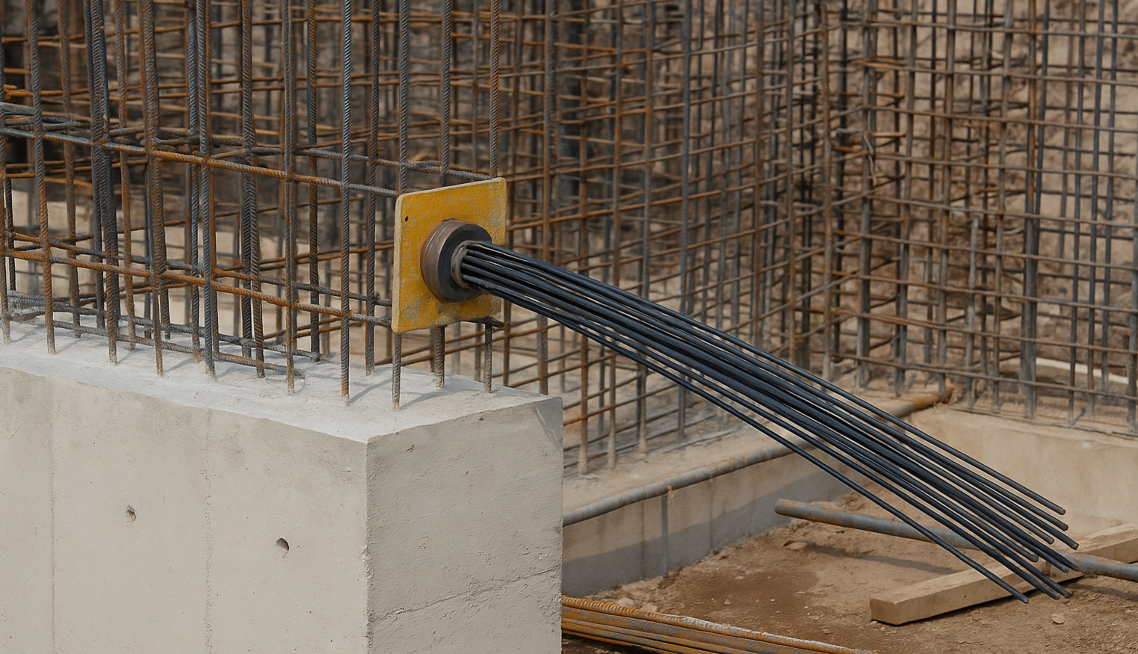
Post-tensioning is a construction method used to strengthen concrete by running high-strength steel tendons or strands through ducts in the concrete, which are then tensioned and anchored after the concrete has cured. This process places the concrete under compression, allowing for longer spans, thinner slabs, and greater resistance to cracking, making it especially valuable in dams, bridges, and large-scale structural projects.
New Sub Head Here
Lorem ipsum dolor sit amet, consectetur adipiscing elit. Mauris a enim aliquam, condimentum nisl a, laoreet lectus. Aliquam convallis sed elit nec vehicula. Praesent gravida, massa sit amet ullamcorper fringilla, tortor nunc ultrices dui, in tristique leo leo sed massa.
Quisque et lectus pulvinar, porttitor mi non, elementum dui. Morbi mi nisl, tincidunt sed venenatis eget, finibus eu mauris. Nullam nisi lacus, feugiat eget varius eget, pellentesque dictum odio. Sed sollicitudin viverra est, at aliquam metus ultrices id. Duis eu purus vel nisl commodo facilisis vitae ut lectus.
Sed elementum dapibus tellus, a dictum metus interdum ac. Nullam condimentum, dui volutpat fringilla molestie, libero tortor ultrices lorem, at tempus diam purus non velit. Aliquam vel nulla eleifend, consequat elit id, tristique massa. Fusce dolor velit, blandit ac erat ac, vestibulum ornare diam.
Curabitur maximus feugiat velit, sed dapibus sem auctor quis. Maecenas turpis purus, tincidunt eget mattis ac, placerat sit amet dolor. Aenean vel porttitor. Maecenas turpis purus, tincidunt eget mattis ac, placerat sit amet dolor. Aenean vel porttitor libero.
SPECIFICATIONS
Materials
-
Strands (bonded/unbonded): 7-wire, low-relaxation steel
— Ø 12.7 mm (0.5″), 15.2/15.7 mm (0.6″)
— fpu ≈ 1,770–1,860 MPa (250–270 ksi); E ≈ 195–205 GPa -
Bars (where used): Ø 26–75 mm, fpu ≈ 1,030–1,080 MPa
-
Ducts (bonded multistrand): steel or HDPE corrugated, Ø 50–130 mm typical
-
Anchorage hardware: wedges + bearing plates per system; galvanised or stainless options
-
Sheathing (unbonded): HDPE with grease corrosion protection
-
Grout (bonded): cementitious, non-shrink, low-bleed
Concrete & cover
-
Concrete strength before stressing: typically ≥ 25–30 MPa (check design)
-
Nominal cover to duct/tendon: interior ≥ 25–40 mm; exterior/exposure ≥ 40–75 mm (environment dependent)
Stressing & acceptance
-
Stressing level: typically 0.70–0.80 fpu (do not exceed system limit)
-
Elongation tolerance: measured vs theoretical ±7% (common)
-
Jack calibration: certified within 30 days/usage, accuracy ±2%
-
Seating loss (wedges): allow ~3–6 mm (system specific)
-
Stressing sequence: from the most restrained end; alternate/multiple stages to control cracks/deflection
Friction & layout
-
Friction coefficient (μ):
— steel duct ~0.20–0.25; plastic/HDPE ~0.10–0.18 -
Wobble factor (k): ~0.001–0.002 per m (system/layout dependent)
-
Minimum radius of curvature: typically ≥ 50–100 × duct diameter (follow supplier tables)
-
Deviators/blocks: provide bursting/anchor zone reinforcement per design
Grouting (bonded systems)
-
w/c ratio: ~0.40–0.45
-
Bleed: ≤ 0.3% (low-bleed spec)
-
Compressive strength: ≥ 17–25 MPa @ 7 days (project-specific 28-day often ≥ 30 MPa)
-
Chlorides: very low—≤ 0.1% by mass of cement (or per spec)
-
Temperature (mix/injection): generally 10–32 °C
-
Grout verification: density, flow, bleed tests each batch; venting from high points until neat grout
QA/QC & testing
-
Tendon ID/tracking per drawing; record jack pressure & elongations
-
Lift-off checks: sample tendons (e.g., 1–5%) to verify residual force
-
Duct pressure/continuity tests prior to grouting (bonded)
-
Protection of unbonded tails: caps + grease; seal all vents/anchorages after grout set
References to align with (South Africa/UK/EU)
-
EN 1992 / BS 8110 practices, PTI (Post-Tensioning Institute) manuals, and local SANS 10100/project specs.